Tuesday, May 31, 2016

Seoraksan National Park - Part II

Day1: Sinheungsa and Biryong falls


After checking into Sorak Park Hotel, we had a short coffee break (I brought my own kopi-o kosong from Singapore. I find the coffee in Korea quite bland.) before heading to the national park. It’s a nice leisurely walk that will take you 15-20 minutes to get to the park entrance. (Or take the bus if you do not want to walk).

The park entrance fee was 3500 won per person. There are no multi-day passes. You just pay each day you enter the park.

It was about 3:30pm when we got to the park. It was probably low season and late in the afternoon. The park was relatively quiet and that was very nice.

My initial plan was to do the cable car trip and then visit the Sinheungsa Temple. However, the cable car was not in operation due to strong winds. BTW, we saw a warning notice that if you take the cable car up the peak and it has to stop operation due to strong winds, then you have to trek your way down! So pay heed!


With the cable car shut down, we visited the Sinheungsa Temple first. Visitors will encounter the stately big bronze Buddha statue first. It turn out to be smaller than what I had imagined, but is still pretty impressive.

The Big Buddha of Sinheungsa temple


The temple proper is slightly further up past a river. Half of the temple ground were closed as some construction or repairs were going on. None of the halls or buildings were particularly spectacular. But there was a nice solemn and peaceful atmosphere which I like.

A stone lantern in the temple compound. The mountain peaks surrounds the temple. It is very atmospheric.

The Hall of Extreme Happiness - dedicated to the Amitabha Buddha


The river by the temple is also very nice and there are steps to get down to the river.

The river that runs by the temple. You can walk down to the river. The bare rocks in the distance is Ulsan Bawi, which we were going up the next day.


With just about 2-3 hours of daylight left, we decided we could still do the Biryeong falls trek. This is a trek to the Biryeong waterfalls and it’s a relatively easy trek with just a slight ascend.

The trails are very well maintained without any big steps. Along the way, you will pass by the Yukdam falls and a suspension bridge.

Suspension bridge on the Biryeong Falls trek. Don't worry, it's very stable!

Part of the trail is a series of stairs mounted on a cliff!


I must say I wasn’t impressed with the Biryeong falls at all… It’s a rather small waterfall. I think what was supposed to be special about this falls is not the size, but the shape. It is supposed to resemble a flying dragon (hence the name Biryeong 飞龙 which literally means flying dragon), though I think it requires quite a bit of imagination…

This is the Flying Dragon falls... Does it look like a dragon?


Beyond the Biryeong falls, you can go further to a observatory to see another waterfall. It looks like a speculator waterfall on the other side of the mountain. The sign says 800m, which seemed near enough. So we started going up the stairs…

After what seemed like a long time, the sign says it’s still 700m away. And when the sign says it’s still 600m after what we were sure was more than 100m of walking up stairs, we decided to turn back. I am not sure how the distance were measured. It definitely wasn’t the distance we walked up the stairs. I suspect it was a point to point measurement…

In any case, the sun had set behind the mountains and daylight was fading. We didn’t want to trek in the dark back (I did bring torchlight for this trip but left it in the hotel…). So we just turned back.

It was about 7:30pm when we reach the entrance of the park. All the restaurants were closed. It was also too late to take the bus to Sokcho for dinner. We ended up having dinner in one of the mom-and-pop restaurant near Hotel Sorak Park. We were the only customers. I had a bibimbap for 8000won. It wasn’t nice… We decided we would go to Sokcho for dinner the next day.

There were 2 convenience cum souvenir stores still open about 8:30pm and we got cup noodles for breakfast the next day.

When we got back to the hotel, the wind really picked up and was very strong. The door to the balcony was banging… I imagine it would be scary if you are still trekking out there in the dark...

BTW, the hotel room has both air conditioning and heater. But we didn’t use either during our stay as the temperature was comfortable for us.

Seoraksan National Park - Part I

I haven't posted for a longggg time. For my last Korea trip, I relied on a few people's blog for information on the trip to Seoraksan National Park. So I thought I would share my experience for others as well. This is my way of paying forward. :)

This is my second South Korean trip. I really didn't expect to be back so soon. But I came to known about Seoraksan and got interested in it. As I did my research, I found that there are really many mountains and nice trekking destinations in South Korean. I believe I will be back again pretty soon.

The highlight of this trip is to trek at the Seoraksan National Park. Seoraksan (雪岳山), means Snow Peak Mountains in Korean and is located on the north easten coast of South Korean. Seoraksan is quite a big national park and there are several park entrance. Most visitors go to the Seorakdong park entrance where the Sinheungsa temple is located and is easily accessed from Sokcho. Those who want hot springs should go to Osaek.

For my trip, I was just doing the simple day treks from Seorakdong.

You can get to Seoraksan from Dong Seoul Bus terminal next to the Gangbyeon subway station or from the Express Bus Terminal in Gangnam.

I took the express bus from the Express Bus Terminal (used to be called the Gangnam Express Bus Terminal, now just simply the Express Bus Terminal. The subway station has same name.) I arrived at the terminal at 8:40 am and managed to get tickets for the 9:00 am bus.

I heard that tickets can be hard to get on weekends and holidays. I was there on Monday in May. The bus was almost full when it departed (on the dot).

The bus was comfortable with spacious seats (three seats in a row). It took the expressway all the way with a 15 min stop halfway. We arrived at the Sokcho Express bus terminal at 11:30am. The journey took only 2.5 hours even though Sokcho is on the east coast (Korea isn't that big after all!).

The Sokcho Express Bus Terminal


There is an Tourist Information booth in front of the terminal. The staff in the booth could speak English and was very helpful. There are maps outside the booth so you still get a map even if it is closed.

To get to Seoraksan, you need to cross the road and take bus 7 or 7-1. The bus fare is now 1200 (as of May 2016). The staff at the Information booth told us that we can't use T-money as the buses here use a different store value card. We ended up paying by cash for the next few days, so it's useful to keep exact change. Actually the bus driver can give change if you don't have the exact change. I think you need to tell the driver how much you are paying. I find it easier just to prepare the exact change.

As we arrived around noon, we decided to have lunch first before heading to Seoraksan. There is a row of small little restaurants along the road next to the Express Bus Terminal (between the terminal and the traffic light). We tried several of these restaurants over the next few days and they were all not bad. These are small mom-and-pop restaurants (actually more of a one-woman operated restaurants). They are quiet and on some days, we were the only customers. They serve the usual Korean food -- jiggaes (stews), bibimbap, sundaes (pronounced "soon day", they are stuffed intestines or squids) among other things. The owners do not speak English but English menus are available. Prices start from 7000 won for a bibimbap or jiggae (most were 8000won).

After a satisfying meal (I'll blog about the food seperately), we cross the road to the opposite side. I was surprised that buses are quite frequent. Both 7 and 7-1 comes roughly every 15 minutes and runs to 9:15 pm. If I had known that, I would have stayed in Sokcho rather than up in the mountains. You only need to stay in Seoraksan if you intend to trek very early in the morning. (In May, there was daylight at 4am).

The bus journey to Seoraksan was only 20 minutes. The bus terminates at the entrance of Seoraksan. We were staying at the Sorak Park Hotel, which was one bus stop before the entrance.

The Sorak Park Hotel is one of the hotels closest to the National Park. There is a Seoraksan Tourist Resort which is right inside the park, but it was closed for renovation. The Kensingston Star Hotel is just outside the park entrance. I tried to look for the hotel for my trip but, curiously, it was not available on several of the hotel booking websites I searched. I thought it was closed. But it was evidently open and looked well occupied when I was there. It looked like a nice hotel and would most likely be beyond my budget anyway.

There are two clusters of hotels outside Seoraksan Park entrance. The Sorak Park Hotel is the nicest hotel among the smaller cluster which is closer to the park. The other cluster is about another km away and has more hotels and shops/restaurants.

The Sorak Park Hotel looked pretty grand from the outside. It has a pointed triangular shape that is quite recognizable. It is perched on a slope, so you do have to walk up the slope from the bus stop. I saw some guests complaining about that. But hey, if you are here to do some trekking, the little slope should not be anything to complain about!

The Sorak Park Hotel


This is a hotel that has seen better times. It used to host a casino as well. All the amenities within the hotel are closed, including the restaurant and convenience store. (I am not sure if they open in peak season, but they were closed when I was there). The hotel was almost deserted when I was there. I only saw one staff at the reception counter, and another cleaning staff. I think only 2 or 3 other rooms had guest during my stay. At night, almost all the rooms were dark.

But the rooms were great, especially since I only paid roughly USD60 per night (for 2 persons, including taxes, excluding breakfast)! The rooms were spacious and you get a great view of the mountain. You can even see the sea and the Sokcho town from the balcony. The bathroom has a bathtub which is nice for a soak after a long day of trekking (but I generally don’t use the bathtub, it’s too wasteful in terms of water and heat use). It’s nice to make a cup of coffee and sit by the coffee table, enjoying the view outside.


Spacious room with nice view of the mountains in Hotel Sorak Park


I didn’t get the breakfast because it was not worth it (it was almost another USD15 per person). You can get bread or instant noodles from the stores near the bus stop. If you are not starting too early, you can actually eat breakfast in the restaurants and cafes within the park. I was surprised to find the restaurants in the park are very reasonably priced. They did not charge “resort” prices -- it’s almost the same as the restaurants outside the park and in Seoul (e.g. 8000 won for a bibimbap).

I stayed 3 nights in Sorak Park Hotel. As much as I enjoyed the hotel, I must say that I won’t recommend staying there if you are just visiting Seoraksan for causal treks. It's not that the hotel is not good (it is!), but because there really isn’t much dining options or activities after dark, and the buses between Sokcho and Seoraksan are pretty convenient and frequent. You are better off staying in Sokcho and take the bus up each day.

In my opinion, you only need to stay in one of the hotels in Seoraksan only if you need to do long treks and need to start real early or may come back late. After the first night, we ended up taking the bus to Sokcho after our treks anyway. 

To be sure, I was there at low season. I am not sure what the bus situation will be like during peak season.

To be continued...

Saturday, October 11, 2014

National Museum of Korea


When I was in Seoul, I made a point to visit the National Museum of Korea because among its collection is a statue of the Pensive Maitreya Bodhisattva which is a national treasure.

The museum is quite impressive. It is quite well curated -- there is plenty of information about the collection in English. I spent some time on the exhibits related to Korean history. After a while, I decided there was too much to take in and I went looking for the what I came here to see.

It took me a while to find it as it was in a special enclosure. The statue was much bigger than I had expected.

This is the statue of the Pensive Maitreya Bodhisattva. National Treasure No 78 

While the artwork of this statue is quite impressive, I didn't find it particularly beautiful. There is suppose to be another statue which I thought was more beautiful (National Treasure 83), but I didn't see it. I am not sure if it was on exhibit at all, or I might have missed it.

However I did find a very impressive statue of the Sakyamuni Buddha. I spent quite some time admiring it as I thought it was very beautiful.

A very impressive and beautiful statue of Sakyamuni Buddha

Besides Korea's own artifacts, the museum also has some acquired from the rest of the world. The Indian section has some interesting exhibits as well.


I thought this is a dancing girl. But this is actually a depicting of the birth of a being in Pure Land. According to some scriptures, beings are born from lotus flowers in the Pure Land.

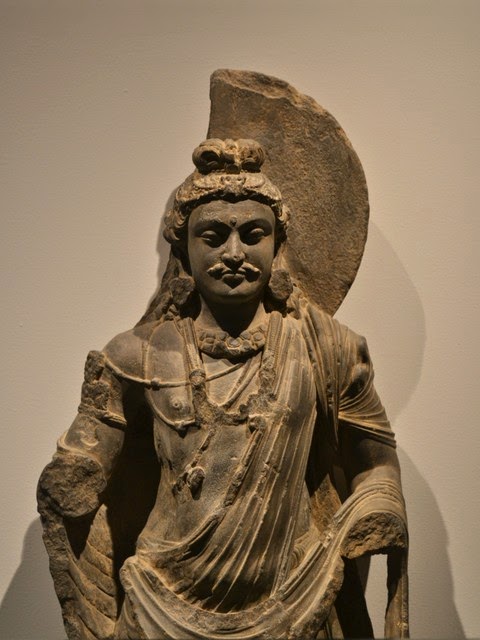
A Gandhara statue of Maitreya with clear Greek influences.


Thursday, October 9, 2014

Hiking through Namsan in Gyeongju


While I was checking out on what to do in Gyeongju, I came across Namsan. What caught my interest was that it appeared to have quite a number of Buddhist statues in the area.

I was going to do the trek on my own, but then I came across a brochure advertising a free English guided tour while at the Tourist Information booth next to the Express Bus Terminal. So I wrote to the email address listed on the brochure and registered myself for the tour since I was going to be in Gyeongju on a Sunday. The tour is available every Sunday except for the winter months.

I was at the meeting point early. Perhaps because it was a Sunday, they were many locals gathering there. They were all suited up in trekking gear. Some had walking sticks and a few had big backpacks. It looked like they were prepared for some serious hiking. I stood out like a sore thumb because I was there only one there in T-shirts and bermudas -- that is, until another 5 Americans joined me for the tour.
Souvenir given for joining the guided tour

The meeting point was Namsan's Information Booth which is run by the Research Institute of Mt Namsan. I picked up an English map there. I was also given a pack of post cards and a button badge as souvenir. The guide for the day was a volunteer called Joey who spoke reasonable English.

We started at Sambulsa temple, which was a small little temple hosting three statues that were found in the vicinity. The guide had some interesting tit-bit to share. She brought us to the back of the temple and asked us what do we see... A phallus? Well, women prayed to the Buddha in hope of begetting a son, hence the Buddha statue was also a phallic symbol. Hmm.... I wasn't sure if I could believe that. But the point is, you won't get such interesting information about what you see along the way if you do not have a guide. So if you can join the guided tour, I would really recommend it. It's free anyway. It is funded by the city government and the guides are volunteers.

Sambulsa (三佛寺, it means Three Buddhas Temple). The statues were found in the surrounding area and put together here. They are made in different era and have different styles (but seriously, you probably can't tell if no one tells you!)

This is the center Buddha statue from the back. It does look like a phallus...

Some abandoned statues at the back of Sambulsa

After that, we passed by many burial mounds. The mountain was a favourite burial ground because it was deemed to be an holy mountain.

Pumpkins put out by the farmers for sale

Then we came to a beautiful pine forest. This is a famous pine forest for photographers, because some famous photographers had taken some very beautiful pictures here, particularly, pictures of the forested in misty mornings. It was a clear day that day, so it didn't looked that good. But among the postcards that was given to me, there was one of the forest in a misty morning and it was really beautiful.
Beautiful pine forest

The photographs of this forest shrouded in early morning fog is really beautiful.

Along the way, there were quite a number of Buddha statues and carvings. Some of these may not be easy to find if there is no guide. A few were quite beautiful, but some were quite crude.
Carving of Buddha on the wall. It is not very clear and the art work is rather rough. But the interesting is the mudra (the hand gesture) of the Buddha image -- it is unique and no one quite knows what it symbolizes.
A beautiful stone seated Buddha. Note that this is made in the same style as the Buddha as that famous one in Seokguram Grotto.

Many brochures of Namsan featured a large seated Buddha carved on a cliff wall overlooking the valley. Unfortunately, they had just closed off that area due to rock falls. That was a disappointment because that looked like one of the most spectacular sight in the mountains, in terms of the large Buddha carving and the view overlooking the valley.

Unfortunately, this is no longer accessible. It's really a pity because this looks quite impressive. It looks like some works is going on, so it may be opened again some time in the future. Note the valley in the background. The view point overlooking this statue was also fenced off, but our guide took us past the fence any way.

Near the peak, there was a Sangseon-am Hermitage, which is a small Buddhist temple. This is were you can fill up your water bottle. There was a tap, but I think it is spring water. I did fill up my bottle and I didn't get any stomach problems.

The Hermitage was quite crowded because this was a major rest stop and because it was serving free vegetarian noodles! I am not sure if they serve this every day, or every Sunday, or if it was special occasion that day. There was a long queue. As much I wanted to try it, I was afraid of holding up the group. But when the America guys in the tour joined the queue, I also joined in happily.
Free vegetarian noodles served by the Sangseon-am Hermitage. I was really grateful for the unexpected meal.

I was glad I queued for the noodles, because it was really good. It was just some soft noodles in a light broth, served with kimchi, chives and seaweed. But it was tasty and satisfying -- way better than the snack bars I had brought for lunch. The noodles were free, but I dropped 5000W in the donation box because I was so grateful for it.

The next stop was the Baduk Rock. This is a vista point that offers a good view of the valley and you can see as far as Gyeongju city. But the most interesting point here is that there is a post box up here! There are postcards in there. You can send yourself a postcard from here and the Gyeongju city will pay for the postage! My card arrived at my house 1 week after my trip. So do send yourself or your friends a postcard from here.
A postcard I sent to myself from Baduk Rock. Postage was paid for by the Gyeongju city. I had forgotten about this and was quite happy when it appeared in my mail box a few days after I got back to Singapore.

This would have been the end of the guided tour and we would turn back and head back down to where we start on the same trail we came up. But a few people needed to use the toilet. So guide brought us to the Geumobong Peak which was another 800m away (but not much climbing as most of the climbing was on the way to Baduk Rock). This is the only toilet along the trail. And this is were many of the locals stop and have picnic.

I parted ways with the tour group from here because I wanted to down via another trail that ends at  Yongjang. I wanted to see the Buddhist artifacts along that trail. But first I had to fill in a survey form about the guided tour -- which is what the Gyeongju city asked for as a "pay-back" (the tour is funded by the Gyeongju city). Of course one of my feedback was that the city should keep funding the excellent tour. :-)
Dragon fly on a stack of stones... Taken some where along the trails.

It turns out that trail from the Geumobong Peak down towards Yongjang was very different from the way we came up. It was steep and definitely a more strenuous trek.
Some parts of the trail from Geumobong Peak towards Yongjang-ri is so steep you practically have to abseil down using a rope. Luckily these sections are quite short. Going up will be a lot tougher.

First, I came across a very sandy and pebbly stretch which was quite treacherous and I slipped a few times. Then was a section that was so steep I was practically abseiling down using the rope.
You can see the valley from the mountain.
An old stone pagoda on the Yongjang part of the trail. You won't see this if you turn back and go down the same way you came up.
Another interesting Buddha statue. Note that it is seated on a rather unusual three tiered lotus pedestal.

After the steepest part of the trail, there rest of the trail was easier. It passed through a more densely forested area and some part runs along a river. However, you need to be careful about there are some false trails. It took me 2 hours to get down from the peak. (Going down the same way where we came up would take 1 hour according to the guide).
Some parts of the trail are literally at the edge of the cliffs. The sign with the falling bear is cute, but the danger is real. My stomach was queasy at some of the stretches.
A suspension bridge
Waiting for bus outside Yongjang-ri village.

I was glad I took the other trail down as there were some quite spectacular sights along this trail.

The Yongjang-ri village was quite interesting too. It is a farm village and can smell the cows. There is an interesting old church with a bell tower.

As I waited for the bus along the deserted road outside the village, I had a flashback -- it reminded of a previous trip to Taiwan, when I also stand alone at a bus stop outside a fishing village, waiting for the bus along a quiet and lonely road.

We started the trek at 9:30am and it was 2pm when I reach Yongjang-ri village. It was a tiring, but an enjoyable trek. It's a mountain that is rich in history and the scenery is nice. Apart from the exercise, it was also a good cultural experience trekking among the locals (I was a little amused as I thought they were over-dressed/geared for the trek. But this does match what I see on the Korean dramas.)

A map I picked up at the Information booth. I followed the tour to the peak and then we parted ways. I used this map to navigate down to Yongjang-ri village. There is Stone Medicine Buddha statue on the map, but I didn't manage to find it.

Getting there:
1. Buses 500, 505, 506, 507, 508 goes to Namsan. Pick up the "Explore Mt Namsan in Gyeongju with an English-speaking guide" brochure even if you are not joining the tour. The brochure has a map on where to take the buses from downtown Gyeongju.
2. It's just a short ride to Namsan (about 10-15 min). The fare was 1500W by cash (I paid 1500W for all bus trips in Gyeongju regardless of the distance. That appears to the be standard fare if you pay cash). You cycle there if you have a bicycle -- it's not very far from downtown Gyeongju, and there are bicycle racks for you to park your bicycle.
3. There is an information booth at the Seonamsa car park. It was just opening when I reached there at 9am. You can picked up English maps from the booth. According to my brochure, it is only opened Thurs-Sun and holidays, 9am - 5pm
4. The way up from the Seonamsan carpark is very well marked. But if you intend to come down the the trail leading to Yongjang, make sure you get a map. Be prepared for a tougher trail with steep slopes.
5. The only water point is at Sangseon-am Hermitage. Bring enough water and perhaps some food. The locals pack food and picnic at the peak.
6. Going up and down the Samneung section, i.e. from Seonamsan car park to the peak, takes about 3-4 hours, depending on how long you break in between. (The guided tour was supposed to end at 1pm back at the starting point). If you take the Yongjang section down, it will take another extra hour. But there are a few points along the way where you might linger especially by the river.

Vegetarian in Gyeongju

Apparently, there is only one vegetarian outlet in downtown Gyeongju. That should tell you how difficult it is to get vegetarian food in Korea.

Happy Cow list a few other restaurants but they are all in the outskirt and not easily accessible for a tourist. However, I did met a New Zealander who relied on Google Maps and cycled to the Baru restaurant which serves Buddhist Temple food. I didn't try to find my way there.

You can't really miss Kong Story if you came to Gyeongju by bus. It is directly opposite the Express Bus terminal. I saw it just as I was crossing the road from the bus terminal.

Kong Story is just directly opposite the Express Bus Terminal. It's a small place.

I was glad to find a vegetarian outlet. But I was disappointed when I walked in and saw the menu. I was hoping for Korean food, but Kong Story sells falafel only. Just falafel. But the disappointment quickly dissipated when I bite into the falafel. It was simply the best falafel I have had so far!

The menu. If you want a meal, there are basically only 4 choices: Pita Falafel, Tortilla Falafel, Veg Burger and Panini Toast.
The menu with the price listed

I had ordered a falafel pita bread wrap with humus. It came with 4 falafels and some shredded vegies in pita bread. I choose to add humus which costs another 1000W. Honestly, I wasn't sure if the humus made any difference. I couldn't taste it. But that might be because the taste of the falafel overwhelmed it.

I had a pita wrap and banana shake. The wrap came with 4 falafels, but the falafels were really good and I order 2 extra falafels! I came back the next day and order more falafels for snacks.

First the falafel smells really good. I am not sure what they used to make it so fragrant. But the smell really brings out your appetite. It is crispy outside, though a little dry inside. And the taste was really really good. I haven't tried too many falafels. But this time, it was so good that it really made an impression on me.

This small outlet is opened by a couple -- an Israeli and his Korean wife, just early this year. They are very friendly and speak good English. It is a very small place that really caters to take-out orders. But there are a few seats inside if you want to have your meal there, though the space is really tight.

I came back the next day in the afternoon and bought some falafels for snacks -- just falafels. At 500W each (about US$0.50, S$0.60 each), I thought they were quite cheap. (Falafels are not cheap in Singapore -- if you can find them in the first place). I ate 2 first and kept the remainder for later. The aroma filled the room and I was constantly reminded of the falafels that was still there!

When I was leaving Gyeongju for Seoul, I dropped in at 9:30am, hoping to pack a falafel wrap for my lunch. Unfortunately, they were just opening and the falafels were not ready. It was also the day they had to change the frying oil, and they could fry them on the spot for me. But the lady boss said she could make me a vegetarian burger, so I settled for it. The burger wasn't bad and the vegie patty in it was quite tasty. But it was nothing really special. I really much prefer the falafels.

Their opening hours was listed as 9am - 7pm. So if you want to have dinner there, you do need to go there early.

And if you came back from your day trips late, I guess the best thing is to cook your own dinner. I was glad that the guest house where I stayed -- Sa Rang Chae -- had a spacious and well equipped kitchen for guests to use. I bought some grocery from a nearby supermart and cooked dinner. (And of course, it is cheaper to cook your own food).

I cooked my own dinner. Just instant noodles with bean sprouts, mushrooms, tofu and some green sprouts (I have no idea what they were, but they looked wholesome and healthy so I bought it.)

Now, when I was trekking Namsan on Sunday, it happened that the Sangseon-am Hermitage was serving vegetarian soup noodles! I was pleasantly surprised as I had prepared to eat snack bars for lunch. I am not sure if the Hermitage serves that every day or just Sundays or if it was a special occasion (it wasn't new moon nor full moon day that day). But if you are trekking Namsan, do look out for it!

There was a long queue for the noodles. They cook the noodles by batches. So the queue actually moved quite fast as each batch was served. 

It was just a simple bowl of noodles in a hot broth, served with some chives, kimchi and seaweed. But it was very tasty and satisfying. (Definitely more satisfying than a snack bar for lunch). 

The noodles were free. But I felt that a donation was appropriate. So I dropped 5000W into the donation box in front of the shrine hall.


This was the noodles served by the Sangseon-am Hermitage near the peak of Namsan. It is simple but tasty and hearty. Just some soft noodles in a light soy broth with chives, kimchi and seaweed. (Yes, chives -- apparently Korean Buddhists do not avoid chives while the Chinese Buddhists do)

Tuesday, October 7, 2014

Vegetarian in Seoul - Dishuifang

The Buddha Light Association or  Foguangshan is an Buddhist organisation based in Taiwan but with many branches all over the world.

In Singapore, there is also a Foguangshan Temple and there is a cafe called Dishuifang in the temple. They have a branch in Seoul too and they also opened a cafe that is also called Dishuifang. (Note: this is listed as "Di Shuei Restaurant" in Happy Cow)

After spending a morning at Bonguensha, I decided to head to Dishuifang for lunch. The temple is literally a stone throw away from the Dongguk University station. Once I step out of the station exit, I saw the sign to the temple.

You can see the sign pointing to Dishuifang once you come out of exit 2 of Dongguk Universitry. Just turn into the alley the sign points to. Unfortunately the signs are in Korean and Chinese only. The English words "Tea House" in small letters under the Chinese words "di shui fang" (滴水坊). I hope this picture helps.


The temple looked closed and I hesitated a while before I pushed through the door. There was no body around. But I saw the sign that the tea house was in the basement level. As I was about to go down the stairs a nun came out the office. She was very friendly and spoke something in Korean, before asking in English if I was here to eat. She told me the cafe was down the the stairs.

Being a Buddhist, I went into the shrine hall and paid respects to the Buddha before heading to the cafeteria. The cafeteria was quite busy the first day I was there.

I wasn't sure if the staff were Koreans or Taiwanese, so I spoke English at first and they had some problem understanding. Then they spoke to each other in Mandarin, I realized that they are from Taiwan. That solved the language problem!

They had an all-you-can-eat lunch buffet that can be had for 6000W. There was also a menu from which I can order main courses like noodles. The buffet spread looked good so I decided to have the buffet. But then I got greedy and order pot stickers too (5000W).

The food here is Taiwanese Chinese food, home-cooked style. There were 5 to 6 simple but delicious dishes. There was also soup and fruits.


Inside the restaurant. Cozy environment. The dishes are laid out on the table and you help yourself to what you like.

Mix grain rice with various dishes home-cooked style. The soup was the best. It had lots of stuff in it: barley, lotus seeds, TVP, and various Chinese herbs.

The only Korean dish was a bowl of daikon kimchi that appear to be still fermenting as it was fizzling with bubbles.

I thoroughly enjoyed the meal. The best of all the spread was really the soup. I keep going back for more. I must have had 4 or 5 bowls of the soup.

Pot stickers (10 per order) 5000W. The filling is a mixture of mock ham and cabbage and other vegies. Nothing really fantastic about the filling. But the skin is good. The underside is crispy and the top side is chewy (QQ according to the Taiwanese). It was served hot and will make a very good snack.


I was back again on the day of my departure. It was very quiet and I was the only guest there. The other table was the nun and the temple staff. So the buffet spread was also the meal for the temple staff. The dishes were all different this time. There was a stewed peanut which I overhead that it had been stewed for two days.

I must say 6000W for all-you-eat buffet is a real steal. While the dishes are simple, they are really good and with home-cooked goodness. However, I do find the dishes tend to be a little bit salty.

The down side is that it mainly Chinese food. So while you are in Korean, you do want to try Korean food right?

For Chinese Buddhist, the good thing is that the temple serves strict Buddhist vegetarian fare, i.e. no eggs, no garlic/onion/chives/leek. Milk products is acceptable in Chinese Buddhist vegetarianism, but not common. I was talking to someone at Dishuifang and they were tell me that the Korean Temple food may contain garlic/onion/chives/leek. So far, I have found chives in the Temple food. Haven't encountered garlic and onion yet.

They are open from 11:30am to 7pm daily except Sunday. They had started a lunch buffet earlier this year. The lunch buffet is served from 11:30 - 2pm. You can order from the menu if you come at other time. Unfortunately, they close quite early for dinner.

Vegetarian in Seoul - Loving Hut

Loving Hut is an international chain that is opened by a religious movement based in Taiwan. I am glad that it has a few outlets in Seoul.

If you are staying in downtown Seoul, the most accessible outlet is probably the Sinchon outlet. It is listed as "Loving Hut Yonsei University" on Happy Cow, because it is located near the university gate.

Take the metro green line #2 and alight at Sinchon. Take exit #2 and walk down the busy road of shops. The shop is along the main road, so it was quite easy to find.

Inside the restaurant. It's self-serve.


What I like about Loving Hut is that there is quite a variety of Korean food and there is an English menu with pictures of the food. The price is not expensive too.

The menu has English captions and pictures
Drinks and ice cream also available.


There were so many dishes I wanted to try, but my stay in Seoul was short and I only came here twice.

The first day, I had a bean paste bibimbap (Soft Tofu Gang Doenjang Bibimbap, 7000W).

It came was a bowl of bibimbap, a small sizzling pot of bean paste and a bowl of mashed tofu. I wasn't quite sure how it is supposed to be eaten. But I decided to pour the mashed tofu into the pot of bean paste and it turned out right. I am not sure if I was suppose to pour the mixture into the rice and mixed it up. I ate it separately. It's not bad, but nothing really memorable.

The main course comes with 3 small side dishes: kimchi, some greens (looks like garlic stems, but I can't really tell) and seitan. I like the kimchi. It's the type without the fermentation smell and is slightly sweet and spicy.

This is the Soft Tofu Gang Doenjang Bibimbap. 7000W. I poured the bowl of white mashed tofu into the sizzling pot of bean paste (Doenjang means fermented bean paste) and mixed it up.

I like the kimchi from Loving Hut. It's a little sweet, without the fermentation taste.


After the meal, I decided to try the vegan ice cream. The ice cream is sold by weight. 100g costs 3900W, which gives 2 small scoop. I tried the pomegranate flavour and was pleasantly surprised to find that it was really good.

Pomegranate ice cream. I really like this.


The next day, I was back for dinner again. This time I ordered the Soft Tofu Pot Stew. I had tried this dish many years again when I was in Portland Oregon. It was so memorably delicious, I had been looking for this in Singapore for many years, but just couldn't find the vegetarian version. I was so glad Loving Hut had it on the menu. (I had wanted to tried it the first day but got distracted by the Doenjang Bibimbap).

However, when it came, I was a little disappointed. First, the portion was small (I had imagined a bigger "pot"), Then it didn't look like what I had so many years ago. The soup wasn't red and the tofu was mashed. But when I tucked into it, I found that it was quite good too. Not quite the same as the original (though seriously, I can't remember how the original tasted like), but quite tasty nonetheless. I must warned that it is rather spicy (which is how I like it).

Soft Tofu Pot Stew - Spicy and good!

One of the sides was lotus root. This is sweet. It's tasty, I liked it.

I wanted to try more dishes but another main course would be too much. So I ordered a side dish of Spicy Fried Soy Meat. This turned out to be a disappointment. The texture of the "meat" was more like gluten balls than TVP meat. It wasn't spicy at all and it tasted like a regular Chinese sweet and sour meat dish.

Spicy Fried Soy Meat -- not bad, but nothing special. It is more like a regular Chinese sweet and sour dish.

Overall, I enjoyed Loving Hut. It is conveniently located. There is English and pictures on the menu to help you decide what to order. The staff also spoke English. The ambiance is nice and it is inexpensive. Given that vegetarian food is so difficult to find in South Korean, I must say it is really great to find Loving Hut here.


There is a wall of Famous Vegetarian and the Sakyamuni Buddha is listed there. This is a mistake. The historical Buddha was not a vegetarian. He ate what was offered to him, including meat.

After a good meal, I took a nice walk down the street that was buzzing with many activities and did a bit of shopping. Yes, another plus is that it is located along a busy shopping street.